
Heffron and Fitzgerald Book - General Contractors

Thanks to Megan, we have scans of every page from the Heffron and Fitzgerald book.
Heffron and Fitzgerald were General Contractors that worked across Southern Minnesota in the 1920s and early 1930's when they shut down due to the Great Depression.
The Heffron and Fitzgerald partnership was formed on Sept 1, 1919. Ten days later, on Sept. 11, 1919, William Fitzgerald and Kathleen Moonan were married at Sacred Heart Church in Waseca, MN.
We will publish each scan, titled with its building name, including page numbers - as separate, sequential posts. Then later posts - with photos, text, etc about specific buildings - can be always wired directly to the appropriate source photo/scan.
Naming protocols - we will use the prefix 'HF Book', followed by page numbers where available, followed by the full name of the building cited in the Heffron and Fitzgerald book.
The plan is to post these consectutively within the month of June 2023, so they can be easily referenced by date in the site archive.
All family members are welcome to add additional photos of Grandfather Billy's buildings. These can include photos, newspaper storeies, etc.
Enjoy!
NOTES:
Copies of the Heffron and Fitzgerald book still show up occassionally on sites like eBay.
Martin Heffron was 72 years old at the time of the formation of their partnership in 1919. Mr. Heffron died in November 1939 at the age of 90.
++++++++++++
Test Heffron and Fitzgerald book INDEX TEST BELOW:
Link to overview and index for the Heffron and Fitzgerald book.
++++++++++++

THE HENNEPIN LAWYER MAGAZINE, JUNE 1971
TRYING ON ANOTHER MAN’S SHOES
By The Honorable John M. Fitzgerald
Judge of the District Court for the First Judicial District of Minnesota
“Fitzgerald, you’re here for the sale of narcotics, you’re looking at 15 years, your number is 00007, take
off your clothes and put them in this bag.”
This was my introduction to 15 hours of “doing time” in the Nevada State Prison in July 1970.
As a graduate of the National College of State Trial Judges, 1965 session, in Boulder, Colorado, I had been invited to participate in a 2 week graduate seminar on Criminal law, Sentencing, Probation and Correction at Reno. At the time I didn’t realize it, but “Corrections” in the title meant staying overnight in the prison in Carson City. Only the inmates of the prison were aware of the possibility of our coming ahead of time, not the judges.
There were 35 judges from all over the country participating in the seminar with 23 of our number entering the prison. No judge from Nevada, and only one from California, went in because of the obvious possibility of running into some convict who had been before him. The faculty for the seminar had ben recruited from across the nation and, interestingly enough, included Douglas Riggs, former warden at Stillwater; Paul W. Keve, former Commissioner of Corrections in Minnesota and Dr. David Fogel, the newly appointed corrections Commissioner in Minnesota.
INVITATION TO PRISON
For our class sessions we were divided into study groups of nine, and to each group was added two convicts who were then serving long prison terms in the Nevada State Prison. We conducted our classes through these study groups until about Wednesday of the second week, and on that morning we were told that arrangements had been made for an overnight prison experience Thursday evening in the Carson City prison for those who wished to participate in it. Those interested were asked to sign up before lunch on Wednesday, so the necessary arrangements could be made.
There was much conversation about the jaunt among the invitees, and many questions asked of the student cons between the time of the announcement and lunch time, but little, if any, ink had been applied to the sign-up sheet by noon. Exactly two judges had signed, Noah D. Rosenbloom of New Ulm and one other. I hadn’t, and I guess it was mostly because I was just plain scared. Like the rest of my fellow judges, after I had gotten over the shock of attending school with murderers (three student cons were in this category) and armed robbers (two more here), I became almost unaware of the differences in their position and my own with respect to the seminar. However, the invitation changed things in a big way and the reality of “living in”, not with eight hand picked volunteers, but with as many as 400 garden-variety convicts hit me rather hard. Warden Carl G. Hocker had “guaranteed our safety” while in the prison at the time the invitation had been extended, but I guess I had seen too many Cagney and Robison movies, because his assurances didn’t impress me in the least. Subsequent experience in the prison proved that my cynicism wasn’t ill-founded. No one can “guarantee” anyone’s safety in a prison.
When it became obvious that more time was needed, we were told to sleep on it and sign up the following morning, and 21 more did just that. In all, 23 of us were bussed the 20 miles or so from Reno to the maximum security facility in Carson City, at 2:00 p.m. on Thursday, and that trip itself was memorable, if only for the variety of nervous reactions exhibited by all of us.
Maybe it was the age differential (37 to 69 years) which caused the varied reactions, but in any event they were there and painfully obvious to anyone who cared to look. Conversation during the entire trip was strained and the laughter was obviously forced. I also noticed several of the bus passengers with nothing whatsoever to say during the trip and this was definitely way out of character for a couple of them. I’m sure that mine weren’t the only wet palms on the bus.
The main prison in Nevada is located on the outskirts of Carson City. Its exterior construction is not unlike that of Stillwater, and I’d venture the two are also comparable, age-wise. However, in the interior physical setup and in the cell population are where the two facilities part company. Stillwater is larger and handles a greater convict population, but the most obvious difference lies in the individual cells in Stillwater, as compared to the multiple cell population in Carson City.
INITIATION TO PRISON LIFE
Each man was checked into the prison with a greeting not unlike the one I received and then the “sentence” began. First we stripped and were given a “skin test”. That is to say, each part of our bodies was closely scrutinized (including a thorough combing of everyone’s hair but mine!) to insure that no contraband came in. Then we showered with a strong soap and waited our turn to have our hair cut (this is the one step we skipped), and to be deloused with a hand operated flitgun. Next we lined up and came eyeball to eyeball with another guard, who again examined us from stem to stern, as a double check for contraband and also to call off to a stenographer-trustee any identifying marks or features on our bodies. Finally, after possibly 45 minutes to 1 hour of standing around a rather sizable, drafty room in the altogether, we lined up and were issued our prison garb of blue denim and were fingerprinted and mugged by trustees.
After we were processed, we were again loaded on our bus at 5:30 p.m. or so, and were taken to a new medium security facility, approximately 10 miles out on the prairie. This prison is approximately 5 years old, and the first thing that struck me as we approached it was the fact that it has only 15 feet or so of the chain-link fencing topped with three strands of barbed wire surrounding it with four corner towers of stone, as compared with the 25 foot stone walls running all around the maximum facility.
Inside, the administration buildings are all fenced off from the rest of the prison, but aside from that everything is wide open. They gym (boxing – gymnastics, weight lifting and basketball are stressed), the kitchen and dining hall (stainless steel everything with cafeteria style serving and permanently anchored round tables and stools), as well as the educational center (classrooms for high school classes – print shop – law library – laundry, etc.) are all separate building facilities, whereas the living quarters are handled a bit differently.
The dormitory facilities are set up by divisions with two in each leg, and with three legs fanning out from a central core area like spokes from half a wheel. The guards (two or three on duty at a time) work from the core area and periodically walk through the divisions day and night. Each division houses 12 men, six on a side, and each man has his own bed and a locker for his clothing and personal effects. Interestingly enough, locks aren’t used for two reasons. First of all, the background of the cons is such as to make use of them laughable and secondly, because the subculture government of the prison deals swiftly, surely and effectively with anyone caught stealing from another prisoner. On one end of the division is a lounging room with couches, stuffed chairs and a TV, and on the other end is a lavatory. Outside the dorms were one baseball and several kittenball diamonds and a football field and a few golf holes.
After checking into medium, we were given our bedding and assigned to our division. I made up my bed and then went out to the yard to meet Benny, one of our student cons with whom I had previously arranged to eat supper. Benny was a knowledgeable 27 year-old, in for aggravated forgery,and had come to the Nevada prison on a hold-order issued to the St. Cloud reformatory authorities where he served time on an escape conviction out of one of our western counties. In both the yard and in the dining hall he pointed out how the Chicano, the Negroes, the Indians and the Whites associated only with their own racial groups despite the fact that the facility was completely integrated. Later I was to learn that this practice was part and parcel, and a direct outgrowth of the rules dictated by the subculture government for getting along in the prison.
After supper, I went back out into the yard and, while momentarily alone out there, I was approached by a con who wanted me to attend an AA meeting with him that night. While we were talking Benny walked up to us and the other con left, without waiting for an answer from me, and I remarked that that seemed odd. Benny laughed to my choice of words, and informed me that I had been conversing with, and almost dated by, one of the several known homosexuals in the prison.
As about 8:00 p.m. or so, I headed back to my division and tried to strike up a conversation with the young Negro in the bed next to mine and with two whites across the aisle. However, all I got were polite yes or no answers, so I decided to try the lounge. The picture didn’t change any there because I was strictly ignored by everyone, so after an hour or so of that I went back and stripped to my shorts and stretched out on my bed.
CELL BLOCK RAP SESSION
I must have laid there the better part of an hour listening to the cons talk over and around me, watching others writing letters and listening to radios and the guitar music from the adjoining division before I heard, loud and clear from the far end of the division, “I wonder what the hell those judges came into the prison for anyway?” This had to be the opening pitch and it clearly was meant for my ears because the voice was raised well above all the others in the division. Besides, I was the only new man in the division and all the cons knew that a bunch of judges had come into the prison that day.
I really didn’t know what to do or to say at the juncture, but I did feel that I had to respond if anything worthwhile was ever to get rolling. In addition, I was fearful that another opportunity might not present itself, so I said, “Why the hell don’t you ask one? That’s the only way you’re even going to find out.”
Actually, the words came out before I even had much of a chance to think them through, and as I heard myself voicing them I couldn’t believe my ears. Truthfully, I was scared to death. However, I needn’t have been because I must have said just the right thing. Within seconds the man who proposed the question, as well as six or seven other cons, were seated or standing on or near the adjacent beds eager to talk and listen.
Right from the start it was obvious that Ralph, the man who voiced the question, was in charge of that division. All of the others deferred to him and no one spoke until Ralph was through speaking his piece. Ralph’s first query was, “How come you just came in here and laid down on the bed? You didn’t expect to learn anything just by sleeping in here, did you? Why didn’t you start something going?” When I told him I figured I has in someone else’s back yard and that for that reason I thought it would be better for me to wait until someone made a pitch to me, a couple of the cons backed me up and reported that I had tried to talk to them, but that they had “cooled me”. This seemed to satisfy Ralph on that score because he took another tact. “I wonder what kind of man holds himself in such high esteem that he thinks he’s capable of judging the habits and actions of his fellow men” was his next question. “I mean, it must take some kind of a super ego for a man to convince himself that he is qualified to pass judgment on other men.”
(Let me sayright here that Ralph was about 40, had done time in California for armed robbery, had served time on a lesser degree of murder in both Folsom and San Quentin, and was serving “life without the possibility of parole” in the Nevada prison for another murder. Like many of the cons he was a bit of a philosopher, but unlike most he was quite intelligent.)
This question really was loaded, so I stalled for thinking time by stating I had been appointed to the job and hadn’t really asked for it, but this didn’t go down because Ralph was well aware of the fact that all state judges stand for election sooner or later. Then I leveled with him and said I didn’t look at it in that light at all, but rather that I felt that any kind of society, even one such as exists in a prison, has to have its rules or there would be chaos. That whenever there are rules somebody is not going to pay attention to them, so there has to be someone to enforce the rules. In other words, someone has to do it, why not me? Surprisingly, this seemed to do the trick because from that point on the tension seemed to ease a bit.
Ralph then launched into a long dissertation on how he agreed that there had to be rules, but he said that for some reason or other he just couldn’t seem to stay within them no matter who it was who laid them down. I was rather taken aback at how quickly he had gotten off me and into matters where there could be a dialogue, but I reflect on it now I’m satisfied that Ralph was merely sounding me out at the start to determine whether or not I was on the level. When he was satisfied that I was, he quickly got into the talk area because that is what he really wanted to do. The idea that 23 judges who didn’t have to, came into the prison for an overnight stay impressed as well as intrigued him, and he and all the rest of the cons wanted to get to the why of it and to express their ideas and opinions as quickly as possible.
Right after Ralph’s remarks about his difficulties with rules, Allen, a young narcotics addict, spoke up about his gripe concerning the overlap of the federal and state laws governing the use of narcotics. He had been sentenced under the state law but he would have preferred being sentenced under the federal law because then he could have been sent to the hospital in Lexington, Kentucky, where the doctors could explain to him why he felt such a compelling need for drugs. He didn’t really want to be cured of his addiction, he just wanted the “why” of his need explained to him. The other cons, including Ralph, crawled all over him for his “screwy thinking” and it was obvious to me from their remarks that narcos weren’t held in very high esteem by their fellow cons.
Not too long after our talk began, Ralph took off on the race problem. (There were three young Negroes in our division and one was lying in the bed just beyond mine and directly in front of Ralph. None of these men participated in our conversations.) he really laid it out in no uncertain terms that “the niggers in here better not step out of line or they, by God, would regret it.” It was embarrassingly clear that he was talking now to me as a secondary audience about racial problems in prisons and to the Negro men in the division as his primary audience, and further that he was using the opportunity to pass the word again that the whites were in the majority in the prison and the Negroes better not ever forget it.
He spoke at length about a prison in New Jersey which had a 70 percent black population where he claimed a white man could expect to be gangraped by the blacks within 12 hours after being processed, and his point was that this was always the situation when the ratio went over 50 percent. At no time that night was any response made to Ralph’s racial diatribe and it was painfully clear that his point had been made, in spades!
PRISON SUBCULTURE
I’ve alluded a couple of times to the subculture or convict government in the prison, so let me explain what I mean. In a prison the guards and the warden represent the establishment and they enforce the establishment rules, but the convicts have their own rules and their own form of government to enforce them.
First of all, each minority ethnic group bands together and through a process, almost of osmosis, a leader of the group rises to the surface. This isn’t by way of election nor are any reasons ever given to explain their choice, but everyone, cons and guards alike, knows who the ethnic leaders are.
There are also division leaders in each dorm, and here, too, it’s just “known” who those leaders are without anyone bothering to spell it out. Age, prison experience, toughness and brains all seem to enter into the choice, but none of these criterion necessarily carries more weight than the other. Finally, there is one man who is regarded as the overall con-leader for the entire prison and again he is chosen by that illusive osmotic process. Everyone understands that he is the man and that’s it.
In medium security at Carson City, the man was Tom, a 50-year-old multiple felon from Minnesota doing “life without the possibility of parole” for a double murder in Las Vegas. Tom was one of the cons who participated in the seminar courses in Reno with us.
This development of subculture government is really not surprising when you realize that these men are in prison because they broke establishment rules. Isn’t it logical that they should again turn away from the establishment while in prison by making their own rules and selecting their own leaders?
Minority groups in prisons truly know the meaning of, and practice the principles embodied in the phrase, “In unity there is strength.” To them unity means not only strength, but it often also means their very survival. Wrong an Indian in prison and you wrong all Indians in that prison. Wrong a Negro and you wrong all Negroes. The majority white ethnic group recognizes the value of racial peace in an institution, so if a wrong against a Chicano is righted by the Chicanos, that’s the end of it, so long as it really was a wrong. By the same token the Chicanos or the Negroes are careful to determine that a wrong really has been committed before they act, because they also know well the value of racial peace.
Homosexuality in prisons was not a topic of extended conversation with the group I was with in the prison, but rather was more one of observation. However, I was informed by the cons in class that the younger the age level in prison, the higher the incidence of homosexuality. Benny told me that he experienced a whole lot more of it in St. Cloud than he observed in Nevada. The guards told me after we came out that Ralph was homosexually inclined so I gathered that it wasn’t just happenstance that the man in the bed next to his was serving time for perversion.
During our all-night conversation, this man vehemently questioned the validity of laws against perversion, when those involved are adults and have consented, but he got no support on his position from the other cons, not even from Ralph. From this, and other incidents, it is my observation that the female of the pair was merely tolerated by his fellow prisoners, as a general rule. The cons did express the feeling that if prisons are to continue to be structured in their present form, and they felt strongly that they shouldn’t be, that a program of marital visitations should be instituted to reduce both homosexuality and tensions in prisons. All of them seemed to be aware of the many problems connected with promulgating such a program, not the least of which would be selling the public on its worth, but they felt that the quicker steps could be taken in this direction the better off the prison system in America would be.
CONS EVALUTE PENOLOGY
I would say the biggest gripe all of the cons had was that the parole system, as it is now operating, is absolutely no good. Surprisingly, I didn’t hear anyone in the prison complain about being “bum rapped”. All of them seemed to have accepted the sentences they drew, but they all felt they should come up for parole sooner. Everyone seemed to feel the parole boards weren’t knowledgeable enough about the cases that come before them. In fact, all of them were of the opinion that in Nevada the biggest problem with parole was that there was, in effect, a one man board in the state and that the other board members just went along for the ride.
Here it was interesting to note that the men I talked to all were in agreement that society had to be protected from certain persons and that these people just had to be locked up permanently. We never did get into how to determine just who should be locked up permanently (I was talking to Ralph and one other murderer, a sex pervert, two armed robbers and a narcotics pusher) but, all things being considered, I guess that was understandable. The interesting thing was that all agreed some people had to be removed permanently from society.
Another interesting matter for discussion was the cons’ feeling that up to a certain point in a man’s sentence, incarceration does have a beneficial effect on him, but that if the man remains in prison after that point has been reached, his continued incarceration merely adds to his bitterness toward society and the system. Penologists have long agreed with this maxim, and the determination of just when this point of time has been reached in the sentence of every convict has been the goal of every parole board for a long time. However, the cons feel that boards, as now constituted, never will be successful in their quest because they’ve neither been “there” nor are they “there” now. In other words, parole boards members haven’t experienced incarceration and its effects on a man.
Ralph argued that ideally two or three cons serving time in the prison should be on the parole board for that prison, because a knowledgeable con “living in” with a man is in the best position to know just when that man has reached the point when he should be paroled. I used the word “ideally” because Ralph and all the other cons realized this approach was an impossibility because of the practicalities of what would happen to the two or three con members the first time someone’s application was rejected by the boards. (I might add that other practical objections also come readily to mind.) Nor did they feel that adding ex-cons to the board would help much, because they felt strongly that you have to live with and know a man in prison before you can properly make a judgment on when he is ready to go out.
CONCLUSIONS
My conversations with the prisoners lasted from Ralph’s opening question at 11 p.m. until 5:00 a.m., and I must say in all honesty that its protracted nature didn’t bother me in the least. On the positive side I got an excellent insight into the thought processes of convicts in prison during those 6 hours and on the negative side I didn’t have to lay on that bed and wonder just when some con was going to even up a long-time grudge against all judges.
As I now review my experience of last July in Carson City, I can come to no other conclusion but that my decision not to close my eyes that night, no matter what, just has to go down as one of my most intelligent!
Why did we go in? This question has been asked of me often, but not before I had asked it of myself and had come up with what I felt were valid and compelling reasons.
In the discharge of my duties as a trial judge, it has too often been my task to pronounce the words, “I hereby sentence you to 5 years in the state penitentiary.” I’ve never found it easy to send a man to prison, and until I actually went into the Nevada prison overnight, I had no idea at all of what happened to a man as a result of those words being spoken. I went in because I wanted to try on the shoes of the men who stand before me for sentencing and to wear them awhile to see what happens. I truly believe that I have done this.
I’ve found out that being imprisoned is a terribly dehumanizing experience, from the substitution of a number for a name to the ordered existence imposed on a man.
I’ve found out that family days and marital cottages should be more than just theories. I’ve confirmed in my own mind certain facts which I have long suspected; namely, that our prisons merely warehouse men at the very best, they don’t rehabilitate them, and that 100 percent of our prison inmates are being handled by our correction system in a way that probably no more than 10 percent to 15 percent need be handled.
I also confirmed my long-held suspicion that our correction system as presently structured in America has not, does not and will not accomplish what the citizenry expects of it, that is, the correction of the thought and action processes of persons who break the rules of society.
Finally, I confirmed in my own mind that of all the tools in use within our present corrective system, parole boards and the knowledgeable use of adequately supervised probation by trial judges, carry the most potential for productive reform in the area of criminal rehabilitation.
My short stay in the Nevada State Prison will always remain in my memory as one of the most educational and at the same time most chilling experiences of my life.
Judge John M. Fitzgerald was born in Rochester, Minnesota in 1923, attended Rochester Junior College,
Michigan State University and received his B.S. and LL.B. degrees from the University of Minnesota in
1947 and 1948. He was admitted to the Minnesota Bar in 1948 and practiced law in New Prague,
Minnesota, until being appointed District Court Judge in 1963. Judge Fitzgerald served 3 years as a
fighter pilot in World War II and as a Trustee of the Minnesota Solders Home Board in 1955 and 1956. In
1957, 1959 and 1961 he served as a member of the Minnesota House of Representatives. Judge
Fitzgerald is a charter member of the New Prague Library Board, serves on the Minneapolis-St. Paul
Archdiocesan School Board and has served on the Board of Governors of the Minnesota State Bar
Association. He attended the National College of State Trial Judges in 1965 at Boulder, Colorado, and the
National College Graduate Seminar at Reno, Nevada, in 1970.
NOTES:
John Moonan Fitzgerald
Judge John Fitzgerald
Nevada State Prison
Hennepin Lawyer Magazine
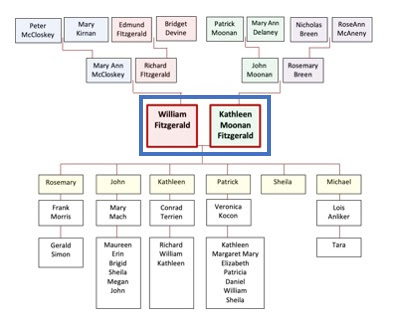
BACKGROUND: William had closed his business in 1931 in the depression, was without a job until appointed project manager for the federally funded Sumner Field housing project in Minneapolis in 1935. He lived in Minneapolis during the week and returned to Rochester on weekends. Kato was raising their then 5 children in his absence. Ro was 15, John 13, Kate 11, Pat 8, Sheila was 4. Kato was 43 and William 49.
(Note by Dr. Sheila: Mailed March 5, 1936 to Apartment 607 Buckingham Hotel in Minneapolis, letters cost 3 cents.)
Thursday afternoon
Dear William, A letter with so much pathetic appeal and a C.O.D. package from Schuslers which cost me thirty eight cents postage which I could ill afford really ought to add up to two letters which would make your record right. I’m just miserable enough today to write in a cheerful tone. I can’t imagine what has happened to me but since last night I’ve been about as sick as I care to be. My head and back ache terribly and I’m a little afraid to attempt anything strenuous like washing which always appalls me even when I start the job feeling perfectly all right. I won’t go near the laundry at all tomorrow unless I feel better. I didn’t sleep at all well last night, just nervous, blue, discouraged and very lonesome.
First pleasant news – the gas bill. I wouldn’t write about this but I thought you should write a strong protest which might prove effective. The bill covers a period from Jan. 20 to Feb. 20 and is $70.92 ($64.47 if paid by March 10.) How much of the below zero weather is included in that period? Do you think we could get anywhere with a complaint? There wasn’t any carelessness because, after that dreadful fifty dollar bill, I personally watched that thermostat and know that the temperature was a little above seventy during the day and below seventy at night. I think a word from you would be more effective than anything I’d say if I went down to talk to them.
Grace came to dinner last night. I gave all the children an early supper, sent the older ones to Devotions and put Sheila, who hadn’t had a nap time, in bed so I hadn’t any worry about them. Kathleen had said her Rosary at noon because Charlotte Anderson had invited her to a birthday supper at five.
This has been a very busy time for all here who go to school. We are going through six weeks tests and, as usual, the results in some cases are very disappointing. John will never do more than just pass, I’m afraid, and it is a shame because he could do so well if he weren’t so lazy and so intent on fooling people. I’ve tried to put him on his own as far as Latin is concerned. He tried to get me to do his work and I made a point of showing him how and leaving him with the job. As a result, he’s failed again. Personally I’m convinced he needs not help in the study, but some sort of stiff discipline. I’m absolutely disgusted with him as he is certainly old enough to have some sense of responsibility.
Pat is as usual a comfort. His arithmetic work wasn’t as good as usual – he brought home a thirty five – but he has been chosen as first prize winner in The Posture Contest for the third grade, which fact he offered as consolation for the Arithmetic mark. Kathleen has averages in her subjects from eighty six to eighty nine which means that she has worked.
I can’t agree that you were “agreeable interesting attractive or sociable” this last weekend. I would say that you tended toward opposite characteristics. I never enjoy being told what to do or that my clothes aren’t becoming. What interesting entertainment did you offer? I really am still young enough to enjoy dissipation more thrilling than grocery shopping and housework. I had planned and hoped for a birthday celebration somewhere away from here – I’d hate to get started on how good any other place would look to me – but my purse contains barely enough to feed the five until Saturday and certainly won’t permit me to travel anyway but by foot. At forty-three, I had hoped for more but, perhaps, as you so cheerfully say, things could be worse – in fact, in most recent memory, they have been so that’s that.
I won’t write anymore. As you can see I am not in a happy frame of mind. After three more of your sad letters, I may cheer up.
Kathleen
NOTES:
Kathleen Moonan Fitzgerald
Kathleen
William A Fitzgerald
William
Letters 1936
Sumner Field Project
Children’s School reports
Latin
The Posture Contest
Thanks to Brigid for retyping this and adding background

This correspondence was with Sheila's binders and retyped by Brigid.
###
June 21, 2008
Dear Sheila,
Pat and I enjoyed the opportunity we had yesterday to chat with you and your family. While the circumstances of the occasion were sad, and certainly all of you wre thinking of John, we did have a chance to remember old Fitzgerald/barker stories. Those days on Seventh and Eighth Avenue seem so long ago and they are. We had an exceptional neighborhood with all those Edison School kids. I mentioned I had three stories to share with you. I told you the two about your mother, feeding of the hobo, something you knew from your own experience, and the TV story.
I‘ve enclosed the third story. I have already sent a copy to Pat and Coke.
I know Sylvia will be interested in a report on your family. Since today is her birthday, I’ll call her and give her the details. She has mentioned enjoying her renewed friendship with you.
Best wishes to all the Fitzgeralds,
Dave
Dave Barker
###
I Betcha
Pat Fitzgerald lived next door to me on Seventh Street. He was my sister’s age, about two and a half years older than I, but we were about the same size. As one of the middle children in a family with six feisty kids, he had to learn to look out for himself at an early age. Every time we got into a wrestling match or other scuffle, I was invariably the loser. By the time I was eight, my life ambition was to beat him at something.
From the Saturday afternoon movies at the Lawler Theater, which offered predominately B grade westerns, we had learned that people get tied up in these films, not emotionally or occupationally, but with rope wrapped around their wrists and ankles. In an age before clothes dryers, every backyard had clothes lines to handle the weekly washing. Our mothers threatened us with severe punishments if we so much as touched these woven cotton ropes. There was nothing that provided rage in a mother like bringing out a laundry basket of freshly washed clothes only to find her clothes line missing. This could result in grounding for life for the culprit. Even so, we somehow always had enough of this indispensable raw material for our inventions and projects.
Not infrequently, playing with the clothes line followed a predictable course, particularly after one of the Saturday westerns. First we would try to lasso each other or whatever was handy. This was much harder to do then we thought. Our cowboy heroes were so good at it They never missed a steer or an outlaw that was trying not get away.
When we finally tired of corralling each other, and being totally unsuccessful at spinning a loop, someone would say, “I betcha I can tie you up so you can’t get loose.”
After several “Naw ya can’t.” or “You couldn’t the last time,” one of us would agree to be tied. We would wrap the victim’s wrists and ankles as we had seen the bad guys do before they left the hero in the mine shack with a lighted fuse burning toward a box of dynamite. Often as not, the “tyee” got away almost as easily and quickly as the movie hero did, though we never had to dispose of any dynamite.
One evening when my father was reading the Post Bulletin, I approached him rope in hand. I was determined to learn the secret of tying up someone so they couldn’t get away. I knew there had to be a system for doing it because the sheriff had to bring in the bad guys after he rounded them up and he had to keep them from attacking him.
“Dad?” I said, holding out my tying rope to him.
“Yes, Dave.”
“How da ya tie somebody up so they can’t get away?”
My father recognized this as a serious question of considerable importance. He put the paper in his lap and thought for a moment.
“What’s the problem?” he asked.
I explained our afternoon adventures and how unsuccessful I had been trying to tie up Pat as I had bet I could.
“Is there some really secret way to tie someone so they can’t get away?” “Well,” he said, “the secret is to tie the person’s hands apart from each other so that one hand can’t help the other hand get loose. You see, if you tie the person’s hands tightly, the only way they can get loose is to until the knots.”
Then he showed me how to tie a square knot explaining that it was the best knot for tying things securely and that it would not come undone by itself. To illustrate, he demonstrated the granny knot which looks like a square knot, but can easily be loosened.
I was fascinated. There REALLY was a secret to it! I was sure I would soon be the best “tyer upper” in the whole neighborhood. I tried to get my sister Sylv to practice on, but she would have none of it. She was highly suspicious of what her slimy brother might do to her once she was unable to defend herself. Tickling might be the least of my tortures. No number of “I promise not tos” would convince her. Younger brother Bob at age four was no challenge, but I was sure my mother would take a dim view if I practiced on him. I was left doing some trial runs on the posts of my bed. I need a resp person to test my new found secrets which could make me king of the neighborhood.
One Saturday morning about the third weekend in June, we were getting ready to go to Gull Lake for a two week vacation. I had been packed for hours, though my mother had redone the job adding several more outfits and much more underwear. I made sure my fishing rod was next to Dad’s tackle box along with my life jacker. With my reputation for falling into any body of water I was near, this was mandatory.
I wandered outside and saw Pat sitting on his back steps playing with the Fitzgerald’s dog, “Rumper”.
Very casually I said, ‘I betcha I can tie you up so you can’t get loose.”
He looked at me in disbelief. “Naw ya can’t. Ya’ve never done it before. I can get away from anything you tie. Remember last week? I set a new world’s records getting loose that time.” “Well let me try again. I think I can doit this time. But ya gotta promise to do what I say.” A betcha is a challenge. It is different from “I dare ya”, which is a questioning of courage and athletic ability such as “I dare ya to climb to the top of that tree over there.” It’s also different from a double dog dare ya, which is a challenge that may involve injury to life or limb, one that the challenger isn’t crazy enough to try. Going down the Eighth Avenue hill in a Radio Flyer wagon would be a double dog.
A betcha is mano e mano, me against you. It has a winner and a loser. There’s a lot of pride at stake.
Pat eventually accepted the challenge. I led him through the gate into our backyard which was completely enclosed by a white picket fence about five feet high. The pickets were separated from each other by 2 inch spaces.
“Now,” I said. “You have to stand with your back to the fence and spread your arms out as far as you can.”
This was a new wrinkle in being tied up and Pat wanted no part of it. I had to repeat my directions several times. I think he sensed that this was not going to be as easy as he had thought. I told him he had promised. I may have thrown in a “don’t be a chicken” or two. Finally, he stretched out his arms.
I tied his left wrist to the farthest picket he could reach. Then I made him stretch his right arm out as far as he could, and tied his right wrist to that picket being very careful both times to use square notes. With the left over rope, I tied his ankles to pickets also.
“Now try to get loose.” I challenged in my most triumphant voice. This time I had him! He began straining as hard as he could, but the ropes were tight. He tried to kick out at me, but I had secured his ankles well enough that he couldn’t reach me. I began to laugh at his frustration which only enraged him more. He kept repeating “I’ll get you for this.” Then I heard my Dad call, “Come on everyone. It is time to go.” I rushed out the gate and was the last one in the car. Quickly we were out the driveway and on our way.
When we had gone about three blocks, I panicked. My vivid imagination was picturing what I would find when we got back from vacation. I knew Pat could never get loose from those square knots. He could never get one had to work on untying the other. I pictured a little skeleton hanging on the fence still tied by the wrists and ankles.
“Dad,” I said sheepishly. “I have to go back home.”
“How come?” he asked.
I knew we had all been looking forward to this vacation and all of us were eager to get gong.
Nobody wanted to turn around.
“I forgot something really important,” I said.
Gratefully he didn’t interrogate me further. He turned around and drove back. When we pulled into the driveway, I jumped out before the car even stopped and ran to the back yard.
To say Pat was furious was a gross understatement. When he saw me all he could say was “I’ll get you. So help me I’ll get you.” And he said it over and over.
Gingerly I went to work on the knot on his right wrist, the one nearest the gate. When I got half of the knot untied, he shook his had as hard as he could and loosened the rest of the knot. All the time he was muttering what he would do to me when he got loose, injecting his comments with words I knew he hadn’t learned from the nuns in catechism school.
I didn’t wait any longer. I sprinted out the gate, raced the short distance down the driveway and jumped into the car. “Let’s go!” I shouted trying to hide my panic.
Dad backed out of the drive and we were off. My only hope was that a two weeks’ absence would be enough for Pat to forget that he had lost the ’betcha’.
###
NOTES:
Patrick William Fitzgerald
I Betcha
Dave Barker


